



Preaching Helps
We have republished Ezekiel Culverwell's headings for every chapter of Scripture in his 1637 work A Ready Way to Remember the Scriptures, having modernized much of the spelling and updated the formatting, while keeping the original capitalization. May this work help you and your household to become more familiar with the 1,189 chapters of holy Scripture.
Paperback
5×8
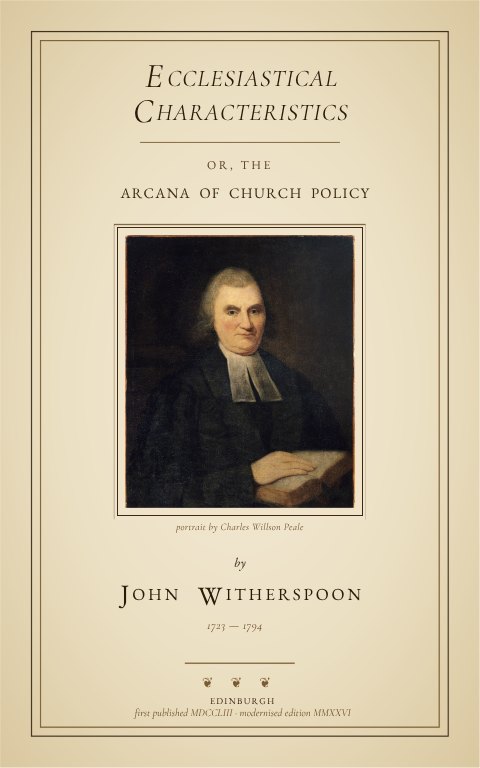
Before he signed the Declaration of Independence, John Witherspoon was a thirty-year-old minister in the Church of Scotland. In 1753, he anonymously wrote this withering satire on the Moderate Party, then ascendant in the Presbyterian Church. Ecclesiastical Characteristics is a satirical manual, instructing Moderates how to trade the Confession of Faith for the polish of a fine gentleman. In it, Witherspoon condemns the Moderates in their own voice. It is an enjoyable yet sorrowful must-read in a day when churchmen are likewise tempted to follow the Moderates’ playbook.
Paperback
5×8
112 pages
LOOK INSIDE

Prideaux categorizes the Sacred Eloquence of Scripture into tropes, figures, schemes, pathetics; characters, descriptions, or ideas; antitheses, parables, similtudes, and similes. We are introducing this work to complement our logic series. As Prideaux writes in his opening sentence, this is “a logical kind of rhetoric, to be used in prayer, preaching, or conference; to the glory of God, and the convincing, instructing, and strengthening our brethren.”
Paperback
98 pages
5.5×8.5
In Sermons to Young Women (1766), Scottish Presbyterian minister James Fordyce (1720-1796) presses the virtues and duties required of young women. This work was despised by the feminist author Mary Wollstonecraft, who addressed it in A Vindication of the Rights of Woman, and it was also mentioned in Jane Austen's Pride and Prejudice, as a book that the clergyman Mr. Collins attempts to read aloud to the women of the Bennet household.
Hardcover
5×8
386 pages
LOOK INSIDE

Franciscus Junius gives a delightful introduction to the Old Testament, showing the nature of it, and how God established the Old Covenant to accomplish the salvation of his people, by His grace. His explanation of the main characteristics of the Psalms is excellent, and Junius also helpfully provides exegesis for the first four Psalms. Freshly translated by Jonathan Tomes, this is a perfect complement to Godwyn’s Moses and Aaron, and will help you get to grips with the Old Testament itself.
Paperback
5×8

In The Divine Trinunity of the Father, Son, and Holy Spirit, Francis Cheynell draws out the doctrine of the Trinity (or as he calls it, “Trinunity”) and its major implications. He reasons from Scripture to prove that the true God, Jehovah, is Triune rather than Unitarian, that all three persons of the Godhead are one God, and are three rather than one or four persons, that Jesus Christ is eternally generated by the Father, and that the Holy Spirit is breathed out eternally by the Father and the Son. Cheynell draws from across church history, citing the likes of Augustine, Athanasius, Basil, Gregory of Nyssa, and others, as well as more recent Reformation-era authors such as John Calvin, Theodore Beza, John Jewel, and James Ussher. Given the proliferation of anti-Trinitarian heresies in our day, this work is as relevant as ever.
Hardcover with dust jacket
348 pages
6x9
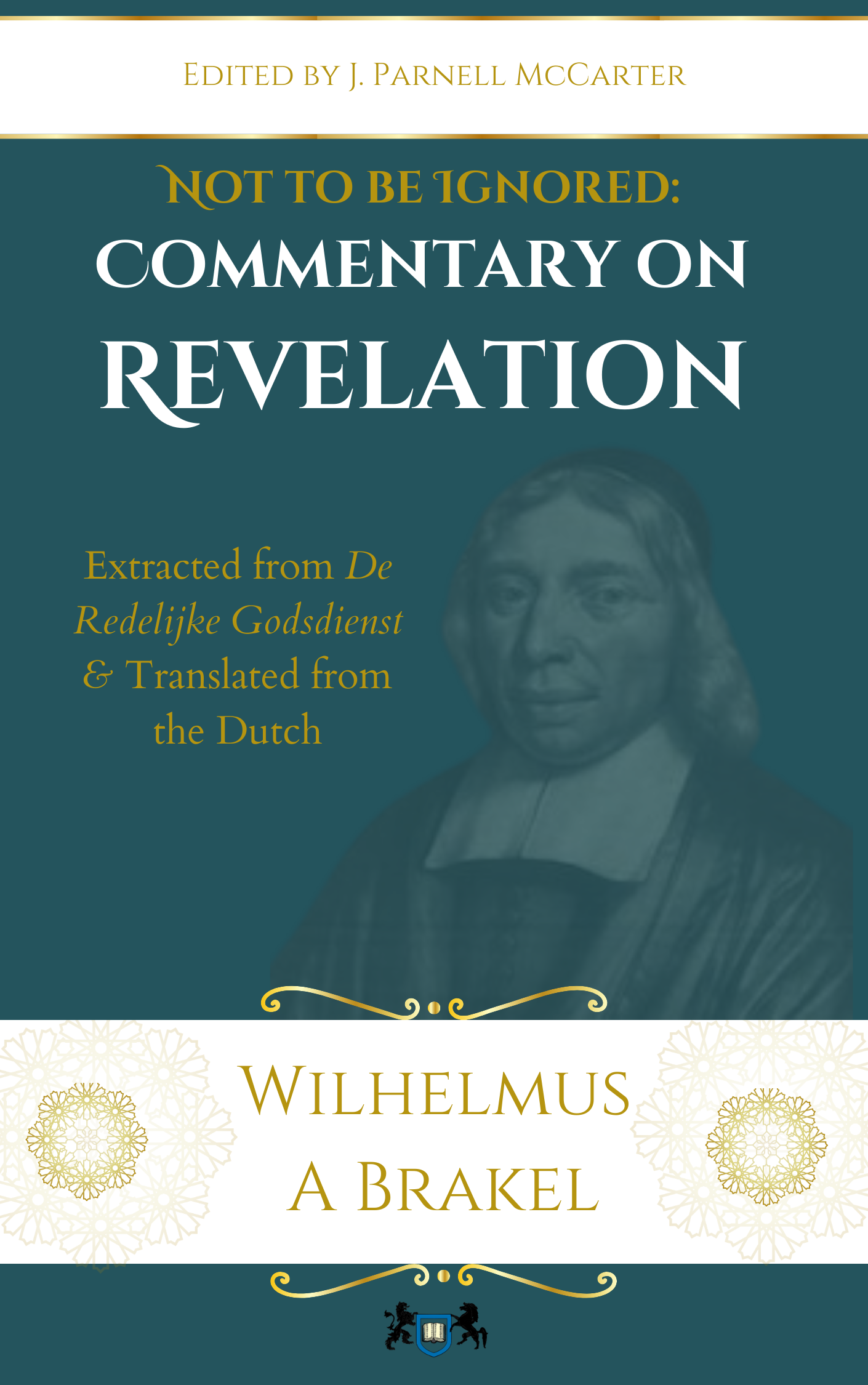
Distinguished Dutch Reformed theologian Wilhelmus à Brakel (1635 - 1711) wrote a compelling commentary on Revelation as part of his magnum opus systematic theology, De Redelijke Godsdienst (The Christian’s Reasonable Service). Now Berith Press has teamed up with J. Parnell McCarter to bring you a new edition of this compelling commentary, available for the English reader. It articulates the well considered reformed mainstream of prophetic interpretation at the conclusion of the Protestant Reformation. It should be thoroughly digested and not ignored. This book is a project of Historicism Research Foundation and part of the Puritans Home School Curriculum (www.puritans.net).
Hardback
6×9
In this pithy volume, Benedict Pictet, the nephew of Francis Turretin, and a masterful theologian in his own right, sets forth a useful polemic against careless indifferency, that is typically found in societies that profess Christianity, while offering platitudes such as all religions being true, or that it doesn’t matter what you believe, or that we must simply obey whatever the magistrate tells us.
Given the spiritual condition of the USA, UK, France, and much of the West, this work is of particular relevance to our situation today, and forms an excellent basis for discussion with family, neighbors, acquaintances, and so on about what ultimately matters most of all.
Paperback
5×8

This work highlights two aspects of the theological work of Alexander Henderson concerning the church. The first work sets out his view of church order, detailing firstly the offices of doctors, deacons, and elders in the church, and secondly how general assemblies, excommunications, presbyteries and synods ought to function. The latter work excoriates the practice of prelacy, which Henderson and his fellow covenanters swore to extirpate.
Hardback
94 pages
5x8
In Domestical Duties, William Gouge exposits that part of Scripture wherein we find domestical duties set forth, namely: Ephesians 5:21-6:9. He goes on to detail the right way that husbands and wives should be joined together in marriage, and their mutual duties. Gouge then sets forth the particular duties of wives, husbands, children, parents, servants, and masters. With over 3,000 footnotes, including several fresh translations, this book is an excellent resource for pastors and laymen alike.
Paperback: 5×8, 8 volumes
Hardcover with dust jacket: 6×9, 2 volumes
LOOK INSIDE
In this helpful apologetic work, Benedict Pictet sets out his defense of the Reformed faith, showing that not only is the Christian religion superior to all others, but also that Protestantism is the only valid expression of the Christian faith, over and against the claims of both the Greeks and the Romanists. This work encourages readers to give a bold witness to Christ, and live for him in the light of eternity.
“In these sermons, the author has employed no pomp of diction, nor the swelling figures of oratorical declamation; as some of the celebrated preachers in that language have done. He expresses native sense, and clear reason, in a style distinguished for its simplicity, conciseness and energy, which is best adapted to the purpose of didactic instruction, and discriminating truth from error.”
~A. Bruce, Minister of the Gospel
Paperback
6×9
320

With a preface from Dr. Todd Ruddell of Whitefield Theological Seminary, these new volumes brought to print enable the Reformed world to access Francis Roberts’ work afresh – newly typeset for the first time in over 380 years, and edited only for readability. Original Hebrew, Greek and Latin phrases have been preserved. These volumes are set to be 6”x9” with a digital cloth cover, complete with a dust jacket as illustrated here.
Francis Roberts produced the most vast Reformed work ever brought to print on covenant theology. Quoting copiously from Calvin, Perkins, Augustine, and others, as well as regularly citing Scripture, Roberts’ volumes contain several thousand footnotes, which have been carefully and diligently placed into these volumes also.
Roberts divides the Covenant of Grace into two main phases: the Old Covenant being the Covenants of Promise, citing Ephesians 2:12, and the New Covenant being the Covenant of Performance, citing Luke 1:72. The Covenants of Promise are, in turn, sub-distinguished into six covenant “expressures”: firstly with Adam after the fall, secondly with Noah, thirdly with Abraham, fourthly with Moses, fifthly with David, and sixthly with the exiles in Babylon. In all these covenants, Christ was set forth in a promissory manner, and salvation was through faith in Christ alone.
Roberts deals with controversies such as whether the Mosaic Covenant was properly a Covenant of Works, whether the Noahic Covenant was merely a universal covenant with mankind, justification by faith as the condition of God’s Covenant, Christ as the formal party with whom God covenants (the church being covenanted as Christ’s body and seed), and also the nature of the Covenant of Works in Scripture – as well as dealing in depth with the Mosaic judicial, moral and ceremonial law, and how the law is and isn't applicable for us today.
Here is an overview of each volume within this set – the first three volumes are coming soon.
Volume 1: Covenant Theology in General; the Covenant of Works; the Covenant of Grace as Expressed unto Adam; the Covenant of Grace as Expressed unto Noah.
Volume 2: The Covenant of Grace as Expressed unto Abraham.
Volume 3: The Covenant of Grace as Expressed unto Moses.
Volume 4: The Covenant of Grace as Expressed unto David; the Covenant of Grace as Expressed unto the exiles in Babylon.
Volumes 5: The Covenant of Grace in its Performance by Jesus Christ, that is: the New Covenant.
Hardcover with dust jacket
Page numbers:
Volume 1 - 552
Volume 2 - 646
Volume 3 - 592
Volume 4 - 592
Volume 5 - 673
6x9
This valuable guide to preaching was considered a key and vital work among preachers during the Reformation, and has been held in high esteem for centuries afterwards. We have updated the spelling and syntax of Hyperius’ work, given it a fresh typesetting, and are now glad to make it available to the general public: a book that is useful for ministers and laymen alike; and also for those studying to enter the pulpit.
Hardback
6×9
In response to the distortions of the Reformed faith from the Amyraldians at Saumar in France, Reformed ministers in Switzerland agreed to the 1675 Helevtic Consensus Formula, which was chiefly the work of J. H. Heidegger. The formula covers topics such as sin, grace, the covenant of works, and the divine inspiration of the Hebrew vowels, points, and accents -- in such a manner as to clearly guide God's people in truth, and refute errors that persist still in our day.
Paperback
50 pages
5x8
In this informative set of treatises, Puritan Thomas Hall provides a powerful defense of humane learning, alongside his rules for interpreting the Scriptures, his guide to rhetorical figures of speech in Scripture, and his sharp polemics against those who sought to tear down the value of scholarship in his day.
Paperback
5×8
214 pages

Thomas Vincent lived from 1634-1678. In his short life, he made a memorable and valuable impact upon the church, providing a very helpful commentary on the Westminster Shorter Catechism. In this work dedicated to the poor, Thomas Vincent plainly and straightforwardly lays out what salvation is, and how we may know whether we are in a state of salvation or not. He also provides a way that you personally may covenant with God, which is most beneficial in our day.
Paperback
217 Pages

In English theological circles, the dispute between those labeled antinomians and those considered neonomians began to rage. Unprecedently, the differing parties resolved jointly to invite Herman Witsius to pass judgment on the matter. The work successfully reconciled the disputants for a while, and was described by Rev. John Donaldson as “an unmatched specimen of theological acquirements, of Christian charity, wisdom, and tact.”
Hardcover with dust jacket
382 pages
6x9
Among the laws of ancient Israel, which applied to Israel qua the Old Testament church, and which to Israel qua a civil national entity? Thomas Godwyn’s Moses and Aaron seeks to answer these questions with skill, and forms a great accompaniment to Bible reading. If you struggle in yearly readings through Leviticus and Numbers, Godwyn provides excellent and clear insight. This work was heavily cited by George Gillespie in Aaron’s Rod Blossoming, and drew the attention of continental Protestant teachers such as Johann Hottinger and Johann Gottlob Carpzov, the former of whom added his comments upon it, while the latter wrote extensive glosses on it in Apparatus historico-criticus antiquitatum sacri codicis et Gentis Hebraeae.
Paperback
5×8
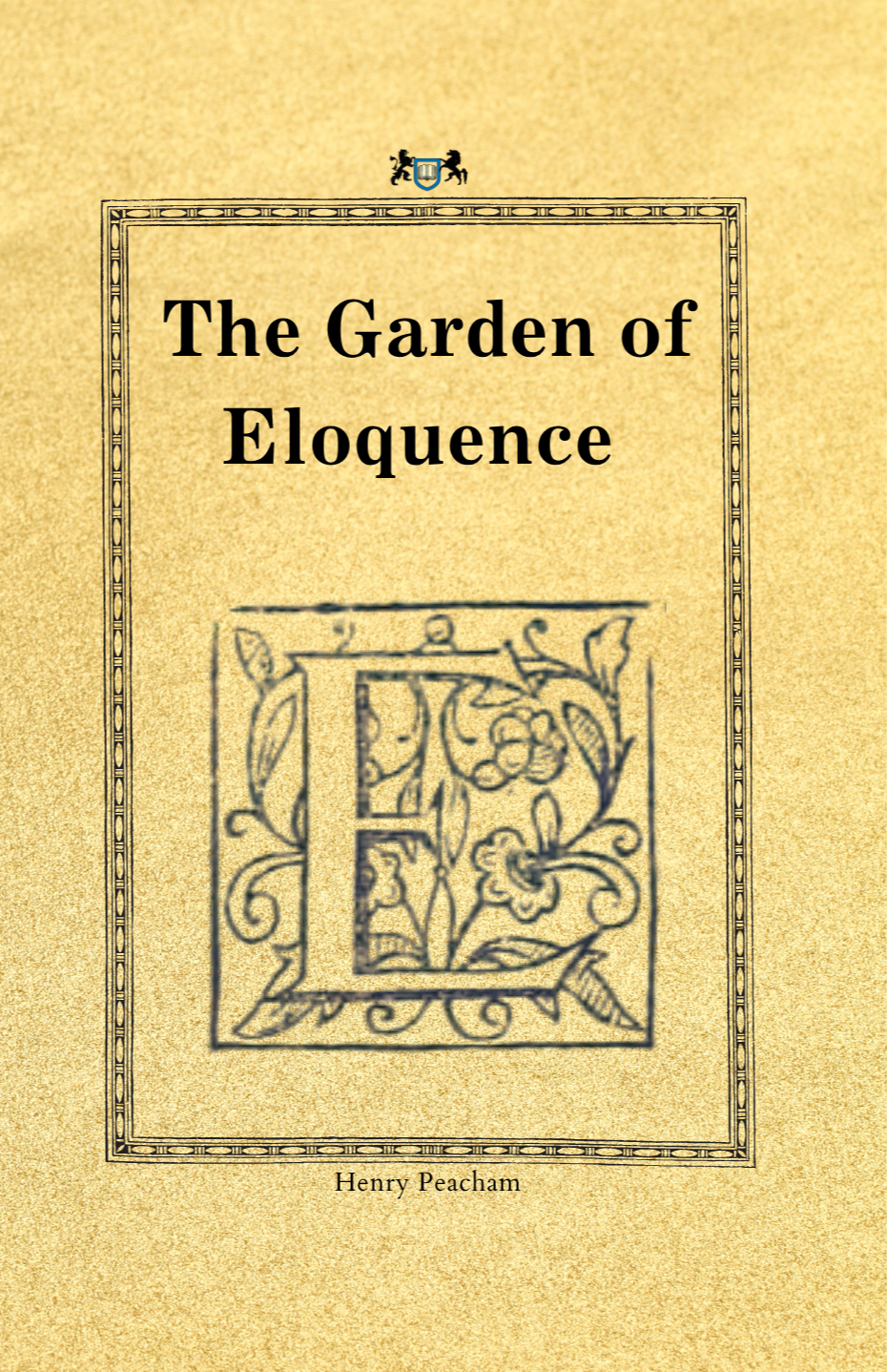
Henry Peacham’s Garden of Eloquence was described by C.S. Lewis as “probably the best” of the rhetoric books from the Elizabethan period. Puritan minister Thomas Hall wrote: “He that would see more Scripture metaphors from seeing, hearing, smelling, touching, tasting, etc., let him peruse Peacham’s Rhetoric.” This detailed work contains nearly 200 points figures of speech, and is an educational masterpiece.
Hardback
5.5×8.5
346 pages

As the Protestant Reformation identified the pope as Antichrist, the popish church of Rome began to develop alternative eschatologies in order to take the heat off the pope. In this treatise, Downame advances the classic Protestant position against Cardinal Bellarmine’s arguments that the Antichrist would rule for 3.5 years, and sit in a material temple in Jerusalem, and that Enoch and Elijah would return to earth physically - ideas that perpetuate in dispensationalism today.
Hardcover with dust jacket
424 pages
6x9
Faithful to the Originals.
We preserve the original words of the original authors, without censoriously and surreptitiously striking out content.